Kaseta vs Plaud – an app against a device plus a subscription
Most pages that compare these two get the category wrong in the first sentence. Plaud is not an app. It is a recorder you buy – Plaud Note, Note Pro, NotePin, NotePin S – that captures audio to its own memory, offline, and then sends that audio to Plaud’s cloud for transcription and AI processing when it syncs with the phone. The subscription is what pays for that cloud, and it is where the transcription minutes are counted.
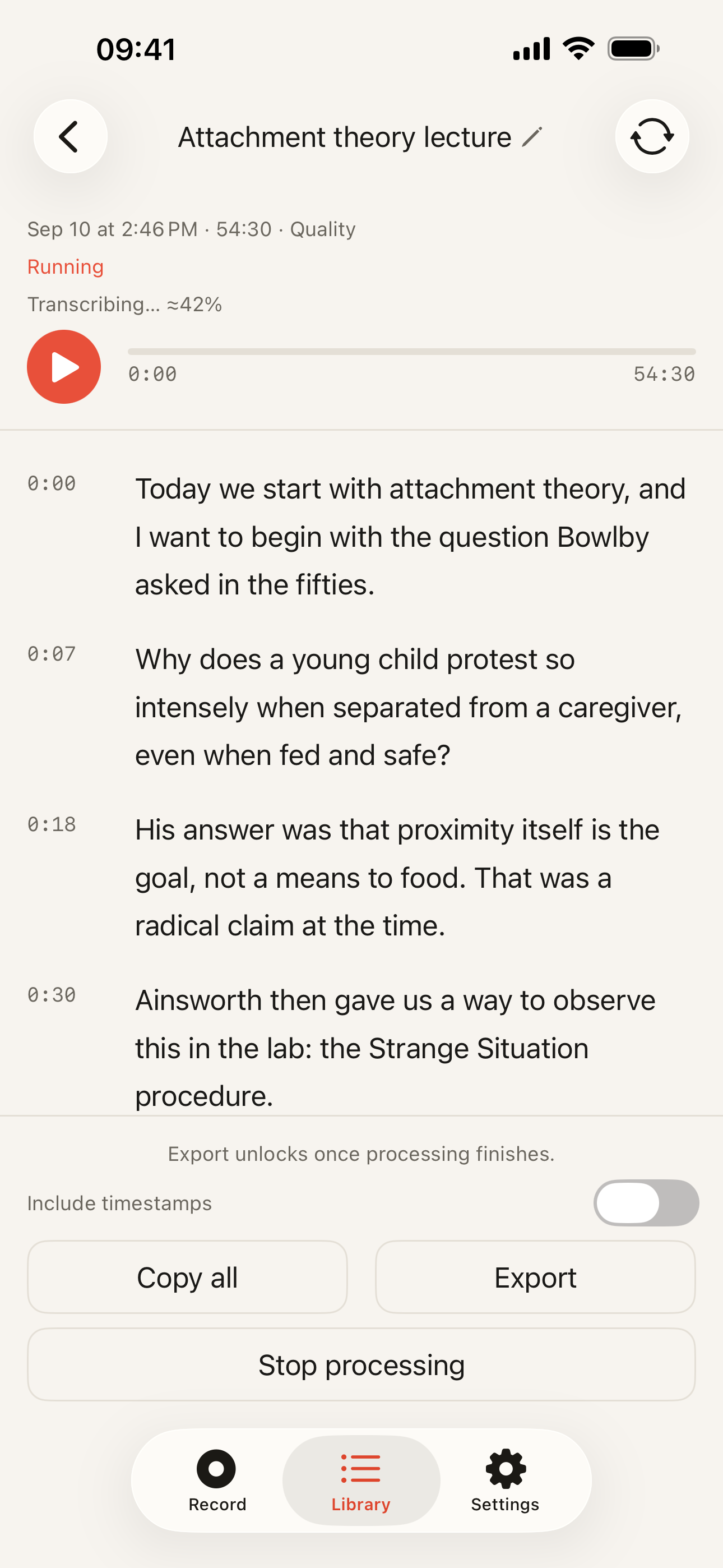
Kaseta is an iPhone app. The speech models are downloaded once and run on the phone’s processor, so the recording and the transcript both stay on the device that made them.
So this is not app versus app. It is a device plus a plan against an app, and almost everything below is a consequence of that.
The short version
- Pick Plaud if the capture is the hard part: a dedicated recorder you clip on or drop on the table, days of battery, memory that does not compete with your photos, and a certified cloud behind the transcription.
- Pick Kaseta if the capture is already solved by the phone in your hand, and what you want is the text without the recording going anywhere.
- There is no accuracy claim on this page in either direction. We have not measured theirs, and a number we did not measure is not evidence.
What Plaud does that Kaseta cannot
This section is the reason the page is worth reading, so it goes before ours.
- It transcribes more languages than we do. Plaud states 112 for transcription. Kaseta’s engine covers 99. Those two counts measure the same thing, and theirs is the bigger one. If your language is on their list and not on ours, nothing else here matters.
- It is dedicated hardware, and that is a real advantage. Plaud Note stores up to 64 GB of audio locally and runs up to 30 hours of continuous recording, with 60 days of standby; Note Pro adds four MEMS microphones, AI noise reduction and a 2.9 mm body. A phone recording a long meeting is doing that with one microphone while it also has a battery, notifications and a screen to worry about.
- It carries certifications we refuse to claim. ISO 27001, ISO 27701, SOC 2, HIPAA, GDPR and EN 18031-1. Plaud also states that recordings and transcriptions are yours, never used to train AI models, never shared with third parties or accessed without permission, and that all data is encrypted in transit and at rest. Our page for doctors says plainly that we hold none of those audits and will not imply otherwise.
- It has a plan for a team. Per-seat pricing, unlimited transcription, one place where a team’s recordings live. Kaseta has nothing of the sort and is not building it.
- It removes the phone from the recording entirely. For anyone who cannot have a phone on the table – or does not want to be the person visibly recording – a small dedicated device is a different social object from a phone held out at arm’s length.
What Kaseta does that Plaud does not
- Nothing is transmitted. Not the audio, not the transcript. There is no server to send it to and no account to send it under, so the question of who processes the recording never opens. Plaud’s recording is captured offline and then goes to their cloud to become text; that is the design, not a lapse in it.
- The whole flow works with no network. Recording, transcription, the finished text. Airplane mode, a basement, a plane, a hospital corridor – tap Stop and the transcript still arrives, because the models are on the phone after a one-time download.
- There is no device to buy, carry, charge or lose. The comparison starts with $159 of hardware on one side and an app on the other. That is not a price argument yet – see below – but it is a real difference in what you are agreeing to keep track of.
- There is no minute allowance. Nobody counts what you record, because our per-minute cost is zero: the computation happens on hardware you already own.
- 99 languages, all on the same on-device path. Fewer than Plaud’s 112, and every one of them recognised without a connection.
The money is a different shape, not just a different number
This is the part a table flattens into nonsense, so it is worth spelling out.
Plaud is a purchase plus a plan. Plaud Note is listed at $159. The subscription that turns recordings into text has a free Starter tier capped at 300 minutes of transcription a month, Pro at $17.99 a month or $99.99 a year for 1,200 minutes – twenty hours – and an Unlimited tier at $29.99 a month; a Team plan is priced per seat. The device is bought once; the transcription is rented for as long as you use it. Plaud gives a one-year warranty and a 30-day return window.
Kaseta is software only. The free tier records without limits and transcribes the first 5 minutes of each recording – the recording itself is never cut off, the audio keeps going and is saved in full. Pro transcribes the whole recording, lifts the monthly allowance on the Quality model, and costs $19.99 a year or $39.99 once. Export in five text formats is on every plan.
These are not two prices in the same currency to be subtracted from each other – dollars of hardware plus a monthly plan on one side, a euro app price on the other – and lining them up as one number would be the dishonest move. What is comparable is the shape: one of them keeps charging for the transcription, and one of them does not. Their numbers are their published figures and they change; check their pricing page rather than this one.
Privacy: two different propositions, not a better and a worse
The tempting line here is “we care more about your data”. It would be false and we are not writing it.
Plaud’s answer to confidentiality is a contract with audits behind it. Your recording goes to their servers, and what happens there is governed by encryption, a stated policy of never training on your recordings or sharing them, and third-party certifications. For a great many buyers – a hospital procurement team, an enterprise with a vendor questionnaire – that is precisely the right answer, and it is one we cannot give.
Kaseta’s answer is that there is nothing to govern. The audio does not leave the phone, so there is no transfer, no processor, no retention period and no breach to be notified about. That is a stronger guarantee in one narrow sense and a weaker offering in every other: no certificate, no audit, no company standing behind a signature, and no recovery if you lose the phone.
Pick by which sentence your situation actually needs. The workplace-policy version of this argument is for no-cloud workplaces.
How to check our half of it instead of believing it
The claim on our side is falsifiable, so falsify it. Put the phone in airplane mode and record. If the transcript appears with every radio off, nothing was sent. If you want a harder check, put the phone on a monitored network and watch the traffic while it transcribes – that needs no cooperation from us. The technical account is in how offline transcription works.
Which one fits you
Plaud fits long days of capture on a device that is not your phone, meetings recorded across a table, a team that needs one plan, a buyer who needs certifications on paper, and anyone whose language is in their 112 and not in our 99.
Kaseta fits dictation, interviews, lectures and client conversations recorded with the phone you already carry, work where the upload itself is the problem, and anyone who would rather not add a monthly bill and a second gadget to get a transcript. Note that the interface itself currently ships in 39 App Store localisations, which is a different list from what it transcribes.
The same comparison against the cloud services is on the Otter page and, briefly, the Notta page; the whole field, sorted by kind of tool rather than by brand, is in transcription alternatives.